8 min read
Digitalizing Nigerian Cooperatives: The Road Ahead, And How to Get Ready
Jide OdunmbakuCOO, Crow-Tech Limited
Nigeria's cooperative sector is enormous, and it's easy to underestimate just how enormous. Over 370,000 registered cooperative societies operate across the country today, part of a global movement that spans more than 100 countries, counts over a billion members, and sustains roughly 280 million jobs worldwide, close to 10% of all employed people on earth.
In Nigeria, that story stretches back to 1935, when the Cooperative Societies Ordinance first gave cooperatives a legal footing. Since then, they've quietly become one of the country's most important tools for financial inclusion. Consumer cooperatives keep goods affordable, agricultural cooperatives back farmers, housing cooperatives help members own property, worker cooperatives share enterprise ownership, and multipurpose cooperatives do a bit of everything at once.
But scale hasn't translated into strength. A large share of Nigeria's cooperatives are still held back by a mix of regulatory friction and internal operational problems, including loan defaults, weak governance, and member apathy. And underneath most of these problems sits one common root cause: paper.
The Paper Problem
Walk into most cooperative society offices in Nigeria today and you'll likely find ledgers, not laptops. Manual record-keeping makes financial audits slow and error-prone, and it opens the door to a specific kind of fraud that has quietly drained public funds for years. Fake or "ghost" cooperative entities exploit weak, paper-based registration systems to siphon off intervention grants meant for genuine societies. Without a centralized digital database, state registries have historically had no reliable way to tell a real cooperative from a fabricated one.
So why haven't more cooperatives gone digital already?
Largely, it comes down to a digital divide. Uneven internet access, inconsistent connectivity, low digital literacy, and tight budgets mean that many orthodox and informal cooperatives simply can't afford, or don't know how to use, new software. The cooperatives that have adopted digital tools have mostly done so out of necessity, one at a time, leaving the market fragmented with no dominant platform serving the sector's real needs.
That's now changing, and faster than most people realize.
The Government Is Moving, And It Started Already
For years, plans for a national digital identity system for cooperatives were discussed as a future initiative. That future has arrived. In August 2026, the Federal Ministry of Agriculture and Food Security, working with the Cooperative Federation of Nigeria and identity technology partner Seamfix, signed an agreement to roll out a national cooperative digital identity system, and launched a six-month revalidation exercise for every registered cooperative society in the country.
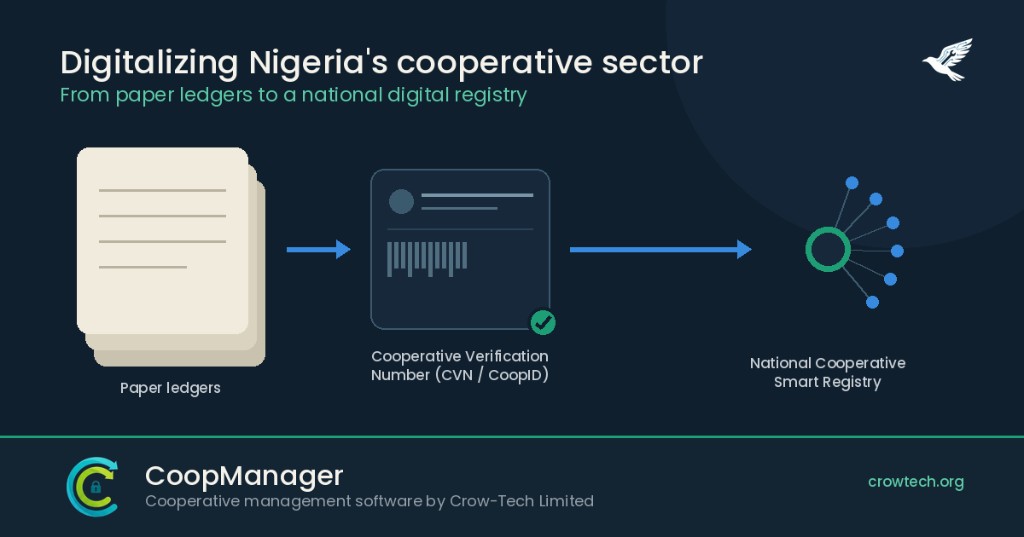
Here's how it works. Existing cooperatives must first approach their State Departments of Cooperatives to verify and authenticate their registration records. Societies that pass this check are onboarded onto the new National Cooperative Smart Registry (NCSR) and issued a Cooperative Verification Number (CVN), a trusted, queryable national identity for the society itself. Individual members will then progressively receive their own Cooperative Member Identification Number (CoopID), linked to both their society and Nigeria's National Identification Number (NIN) infrastructure.
Together, the NCSR, CVN, and CoopID form the backbone of what officials are calling the National Cooperative Digital Architecture Platform (NCDAP), alongside CoopCHECK, a credit bureau component built with CreditRegistry to support responsible lending decisions. The goal, in the government's own framing, is to move the sector from fragmentation and anonymity to visibility, and to give every genuine cooperative a credential it can use to access government interventions, bank loans, and formal partnerships.
Senator Aliyu Sabi Abdullahi, Minister of State for Agriculture & Food Security and Supervising Minister of Cooperative Affairs, has also directed a review of the Nigerian Cooperative Societies Act, aimed at producing a new Cooperative Societies Bill.
A Bank Built for Cooperatives
Running alongside the digital identity push is an even bigger structural change: the proposed Cooperative Bank of Nigeria. Through 2026, the ministry has been touring the country to mobilize cooperative societies around a share capital drive, with a target of raising roughly ₦200 billion from at least 10,000 participating cooperatives nationwide.
The ownership structure is deliberately designed to keep the bank in cooperative hands. Sixty-five percent of controlling equity is reserved for cooperative societies and their members, largely through the Cooperative Trust and Investment Society of Nigeria (CoopTrust). Thirty percent is open to institutional and private investors, development finance institutions, and qualified individual investors, and the remaining 5% goes to bank employees through an ownership scheme. It's a structure explicitly designed to avoid the fate of past cooperative financial institutions that lost their cooperative identity over time, while still attracting the outside capital needed to fund large-scale lending.
For cooperative societies, this changes the equation. Buying equity, receiving dividends, and meeting the "Know Your Customer" requirements tied to CVN and CoopID all require clean, digital records. A spreadsheet or a ledger simply won't cut it anymore. Societies that modernize their bookkeeping and reporting now will be positioned to access serious capital through the new bank. Societies that don't risk being locked out of it entirely.
Awareness Is the Other Half of the Equation
Infrastructure alone won't close the gap. Cooperative executives and members alike need to actually know how to use the tools being built for them, comfortable enough with basic hardware and software to operate whatever management platform their society adopts. Public sensitization campaigns, seminars, and orientation programs will matter just as much as the technology itself in determining who benefits from this shift and who gets left behind.
What Digital Cooperative Management Actually Looks Like
A new generation of platforms has emerged to meet this moment. Early tools like Micmac, Riby, SmartTeller, and CoopSolve helped prove the concept. Bank-backed platforms such as CoopHub, built by Wema Bank, now offer multi-level signatory approvals for withdrawals, automated contribution deductions, and built-in tools for hosting meetings.
This is where CoopManager, built by CrowTech, fits in.
CoopManager is a cooperative management platform built around one core idea: spreadsheets and paper ledgers break down as a cooperative grows, and by the time leadership notices, the reconciliation backlog, the loan visibility gaps, and the audit headaches are already expensive problems. CoopManager replaces the scattered files, the "members_final_v2.xlsx," the "loans_Q3.xls," the branch report sitting in someone's inbox, with one structured system of record.
In practice, that means:
- Member management and KYC. Organized profiles, status tracking, and membership history in one place, instead of scattered across files.
- Savings and contributions. Tracked by type, with receipts and full contribution histories on demand.
- The full loan lifecycle. Applications, approvals, disbursement records, repayment schedules, and overdue visibility, so nothing falls through the cracks between an approval and a repayment.
- Reports and dashboards. Exportable records built for leadership meetings, audits, and internal review, not reconstructed from scratch each time.
- Multi-branch support. A consolidated view for head office, with role-based access so branch teams see only what they need to.
Two details matter for trust, which is the currency cooperatives run on. First, CoopManager is built with role-based access controls and audit-conscious workflows, so key actions leave a clear trail for review. Second, and this is deliberate, CrowTech builds software; it doesn't lend, hold deposits, or act as a financial institution. The platform's job is to give a cooperative's own leadership and members clearer, more reliable visibility into records that already belong to them, day to day, not just during a compliance push.
Pricing follows that same straightforward approach: a flat ₦2,000 per active member per year (or ₦200 monthly), with a 50-seat minimum and volume discounts available for larger societies. Cooperatives pay for the software, and that's the whole relationship.
That kind of foundation matters well beyond any single regulatory deadline. As Nigeria's cooperatives move through revalidation, onto the NCSR, and toward eligibility for the Cooperative Bank of Nigeria, having clean, automated, audit-ready records will help. But the bigger win is what it does for a cooperative every single day: fewer reconciliation headaches, faster AGM prep, and members who can trust what they're being told about their own money.
Looking East for What's Possible
It's worth looking at what this transition could eventually unlock. Nigerian cooperatives operate mostly as micro-lending groups, built around informal savings systems like Esusu or Ajo and salary-based credit for workers, farmers, and traders. Compare that to East Africa, where countries like Kenya and Ethiopia run massive, state-backed agricultural cooperatives that process, brand, and export commodities like tea, coffee, and dairy on behalf of millions of smallholder farmers.
Kenyan SACCOs, in particular, function much like full commercial banks, offering mobile-money integration, insurance products, and large-scale housing finance, backed by robust legal frameworks and dedicated state support. That level of scale hasn't been available to Nigerian cooperatives, largely because regulatory oversight has historically been weaker and less integrated with national economic policy.
Closing that gap is exactly what the CVN, CoopID, NCSR, and Cooperative Bank of Nigeria are designed to do.
The Takeaway
Nigeria's cooperative sector isn't waiting for a digital future anymore. It's living through the start of one. Revalidation is underway. A national registry is being built. A cooperative-owned bank is being capitalized. The societies that treat this as a checkbox exercise will struggle to keep up. The ones that use it as a reason to properly digitize, with clean records, transparent reporting, and real-time visibility for members, will be the ones positioned to access capital, credibility, and growth on a scale Nigerian cooperatives haven't seen before.
CoopManager can help with all of it, not just the parts tied to a government deadline. Since launching, it's already onboarded paying cooperative societies serving hundreds of members, with a growing list of societies moving off spreadsheets and onto the platform.
If your cooperative society is thinking about what digitalization actually looks like in practice, book a CoopManager demo or get started to see how CrowTech can help you get ready.
Ready to digitize your cooperative?
See how CoopManager replaces paper ledgers and spreadsheets with one structured system of record.