10 min read
How Cooperatives Help Farmers Get the Loans Banks Won't Give
Jide OdunmbakuCOO, Crow-Tech Limited
Introduction
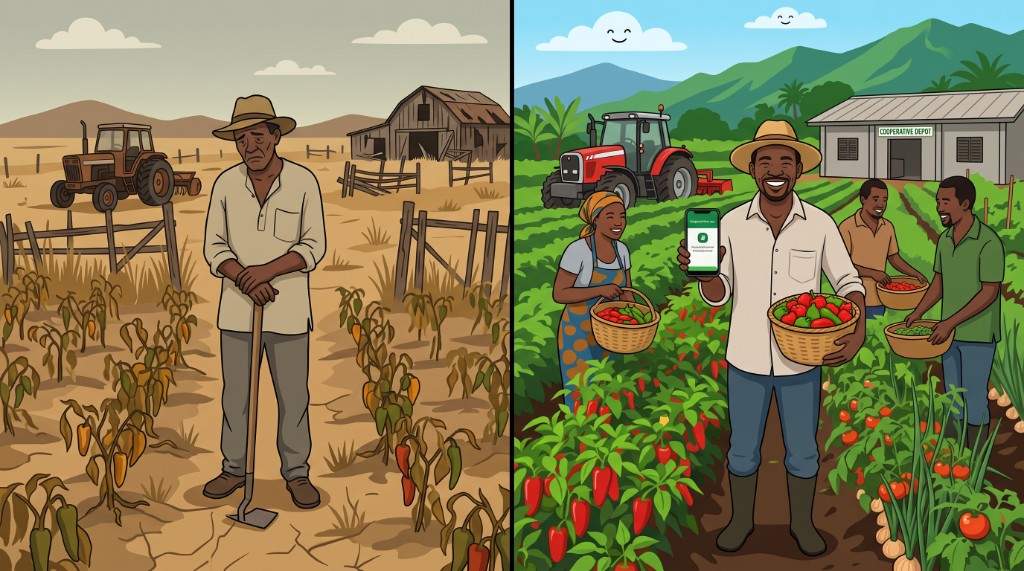
Prices for food like peppers, onions, and tomatoes go up and down all the time, and it's hard to predict them. Picture Tunde, a pepper farmer whose story stands in for what many farmers across Nigeria go through every planting season. Tunde's plan to deal with these ups and downs was simple: grow more. He wanted to increase his pepper farm's harvest from the usual 2 tonnes per hectare to a much bigger 15 tonnes per hectare.
But that season, he only harvested 0.85 tonnes per hectare. A plant disease had destroyed much of his crop and delayed his harvest. By the time his peppers were ready for market, peppers from the North had already arrived and flooded it.
Even after this loss, Tunde did not give up on his big plans. He had the land, he knew there were enough buyers for his peppers, and he had learned a hard lesson about managing crop disease. What he lacked was money: capital for new seeds and fertiliser to grow more.
Tunde needed help, and fast. He went to commercial banks for a loan, but they kept turning him down because he had no formal business plan. He also found out that banks that lend to farmers preferred "group lending" over giving loans to individual farmers.
What is "group lending"? he wondered.
Group Lending & Agricultural Cooperatives
Tunde would soon get his answer. Group lending is built on a simple idea: banks trust a group more than they trust one person farming alone. Instead of asking a single farmer for collateral or a business plan, the bank lends to the group as a whole, and the group's shared reputation, and its members watching out for each other, becomes the guarantee. The exact rules differ from one lender to another, but the basic principle stays the same: a group is a safer bet than an individual with nothing to point to.
At first, Tunde wasn't comfortable with this idea. He had always run his farm alone, answering to no one, and the thought of his loan being tied to neighbours he barely knew felt risky. But the more he thought about it, the more sense it made: one bad season had already cost him a lot on his own. Sharing that risk with a group, instead of carrying it all himself, started to feel less like a danger and more like protection.
Cooperatives take this same idea of shared responsibility and give it a proper structure. They are formal, member-owned organizations, and unlike a small group that only exists to guarantee each other's loans, a cooperative can also help members buy supplies, sell their goods, and save money together, on top of offering credit. For a farmer like Tunde, an agricultural cooperative brings individual growers together to help them run their farms better and grow more.
This was exactly what Tunde needed to hear. Agricultural cooperatives help rural areas grow by letting farmers combine their resources, share risks, and sell directly without middlemen taking a cut. For a farmer like him, that meant lower costs, wider access to buyers, and a real shot at better profit, not just for him, but for everyone in his community.
As Tunde looked into it further, he learned that these groups are owned by their own members: some are small and local, others are large national networks. By working together, members get discounts when buying in bulk, and everyone becomes more profitable through mutual support. For farmers like him, who couldn't get a loan on their own, cooperatives could open the door to government funding. In Nigeria, programmes like the CBN's NIRSAL Anchor Borrowers' Programme are built around group lending, meaning cooperative members can more easily qualify for loans and grants that would otherwise be out of reach for someone farming alone.
Types of Agricultural Cooperatives
As Tunde dug deeper, he found that agricultural cooperatives aren't all the same. They're set up differently from place to place, but they generally fall into four main types. Supply cooperatives help members get seeds, fertiliser, and machinery at a lower price by buying in bulk, while marketing cooperatives handle selling the produce, negotiating prices, storage, and promotion. Thrift and credit cooperatives combine members' savings to give farmers loans at low interest. In Nigeria, these types are often combined into flexible multipurpose cooperatives, which handle supply, marketing, and financial services all at once, giving members full support.
When Tunde looked at his options, he realised that no single type fully solved his problem. A supply cooperative would have made his seeds and fertiliser cheaper, but it would not have saved him from the flooded market that ruined his last harvest. A marketing cooperative could have held his peppers back until prices went up, but it would not have given him the capital he needed. It was the multipurpose type, combining supply, marketing, and loans all in one, that covered his whole problem, not just one part of it.
The Challenges of the Cooperative Model
But Tunde would soon discover that joining a cooperative doesn't solve everything overnight. Despite their many benefits, agricultural cooperatives face real problems. Rising costs of farm supplies and not having enough pooled savings often eat into profits, while worker shortages and disagreements among leaders can easily disrupt everyday work. On top of that, cooperative managers often lack the marketing skills needed to sell members' goods well. Making things worse, most cooperatives are slow to adopt new technology, so they miss out on the time and money that digital tools could save them.
This wasn't just bad luck on Tunde's part; it's a nationwide pattern. In 2025, a research group called 60 Decibels surveyed nearly 5,000 Nigerian farmers. One in five had received a farming loan, but only 5% of them signed up for it, managed it, or made repayments online.
Tunde saw this problem for himself after he joined a cooperative near his farm. The leaders meant well, but they still kept records by hand in exercise books, and members often waited weeks just to find out if their loan request had even been received. What should have been his fastest way to get money ended up moving barely faster than the commercial banks that had already turned him down.
Why Farmers Still Rely on Traditional Methods
Tunde wasn't alone in this. Across the country, the numbers tell a clear story: a survey of 2,000 small-scale Nigerian farmers found that 77% use only basic phones with no internet, and 88% had never used the internet for business at all. Like most farmers in Nigeria, Tunde depended on knowledge passed down from his parents, and advice from other farmers he trusted.
That knowledge still mattered to Tunde, but it made it harder to get the up-to-date information that could have saved his last harvest. His cooperative faced the same problem: without clear, up-to-date financial information, it was flying almost as blind as he was.
Part of this wasn't stubbornness; it was infrastructure. Poor internet access is still a real problem in rural Nigeria. National surveys show that most rural farmers still use basic phones with no internet, and unreliable electricity makes it hard to keep devices charged and working. The cost of data also affects how often farmers use digital services. Even where there is network coverage, farmers tend to prefer simple tools over complicated apps. Like most of his neighbours, Tunde picked up technology that fit easily into what he already did, not tools that asked him to change how he worked.
The Economic Impact of the Digital Shift
Tunde's cooperative wasn't unusual either. A 2024 study of cooperative rice farmers in Anambra State found that they already use their mobile phones for simple things: checking money matters, getting farm supplies, market prices, and weather updates. But more advanced digital tools, the kind that could have caught his cooperative's paperwork backlog, were still out of reach, held back by problems with the farmers themselves, the cooperative's structure, and the technology available to them.
For Tunde's cooperative to change, its leaders needed to believe going digital would actually save them time and cut costs. That belief grows stronger when the technology is easy to use and the cooperative already has some staff who understand it. Outside pressure, like competition from other cooperatives and support from the government, also helps make going digital feel less risky. And leaders who understand technology and keep learning are usually the ones who push the change through.
It was exactly this kind of frustration that finally made Tunde's cooperative leaders rethink their resistance to digital tools. Once they saw that going digital could remove the very delays members like Tunde were dealing with, and that other cooperatives were already benefiting from it, their fear of the change started to fade.
The Quiet Digital Shift
Beyond Tunde's own cooperative, this shift was happening across the whole industry. Agriculture technology (agritech) companies are getting more farmers on board by reaching them through everyday tools like text messages and WhatsApp. Many now use AI to give farmers advice made just for their own farm, instead of generic tips, helping them manage their crops better and grow more.
The World Bank reports that Cameroon is using digital tools to transform its farming sector, giving farmers better access to markets, information, supplies, and modern tools through a World Bank-backed project called PATNUC. By improving internet access, teaching digital skills, and building better data systems, the project is helping farmers overcome long-standing obstacles to growing more and selling more, obstacles not so different from the ones standing between Tunde and his own harvest.
A Cooperative App for Farmers
The same idea applied to Tunde's cooperative and its money problems. For years, many Nigerian cooperatives like his have struggled to get bank loans or government support because their records were scattered and kept by hand. This is exactly the kind of gap a platform like CoopManager was built to close.
By using a platform like CoopManager to keep accurate records of daily transactions and member details, a cooperative can easily produce the reports banks and regulators actually ask for: trial balances, balance sheets, and KYC documentation. This makes it far easier to trust, and builds the kind of standing a cooperative needs to reach bigger markets, outside investment, and development grants.
This change meant everything for Tunde's plans. By using CoopManager to keep clean records and produce accurate trial balances and reports, his cooperative gained the clear, honest financial history that commercial banks ask for. Because of this, his request for money for seeds and fertiliser was backed by his group's solid, documented track record.
CoopManager makes technology easy for everyone. It does the complicated administrative work behind the scenes, while giving members their loan status, dividend updates, and savings balance through a simple mobile app that is easy to use, even for first-time users.
Tunde had never used a banking app before, but checking his loan status on the CoopManager app took just a few taps: no trip to the bank, no waiting on a phone call, no trouble at all.
This same simplicity meant that members who had never been comfortable with technology, like Tunde, didn't have to be. It also freed cooperative leaders from paperwork, so they could focus on growing the group for the long term.
Finally, just as agritech companies now use AI to give farmers advice made just for their farm, managing a cooperative's money also needs to go beyond simple record books. A cooperative that goes digital doesn't just store numbers; it can put them to use. For a cooperative like Tunde's, that means managers can use CoopManager's clear transaction history to spot cash-flow patterns by season, reduce the risk of unpaid loans, and keep lending at healthy, sustainable levels.
Conclusion
The Federal Government has launched a campaign to raise ₦200 billion to fund a new Cooperative Bank of Nigeria, as part of its Renewed Hope Cooperative Reform and Revamp Programme (RH-CRRP). Announced by Sen. Dr. Aliyu Sabi Abdullahi on June 18, 2026, the plan asks 10,000 cooperative societies across the country to invest, at three different levels depending on their size. By bringing all this money together, the government hopes to build a strong, lasting financial institution owned by Nigerians, for Nigerians.
For Tunde, the road from a ruined harvest to a real shot at 15 tonnes per hectare has gone through his cooperative, not around it. Getting the money he needs to grow will still depend on a strong agricultural cooperative. And, as he has already found out, a cooperative that has gone digital and is ready for today's challenges is the one best placed to help farmers like him go further.
Ready to modernise how your cooperative runs, get rid of manual paperwork, and build the trust you need to attract outside funding? Simplify your record-keeping and give your members more power today.
Ready to digitize your cooperative?
See how CoopManager replaces paper ledgers and spreadsheets with one structured system of record.